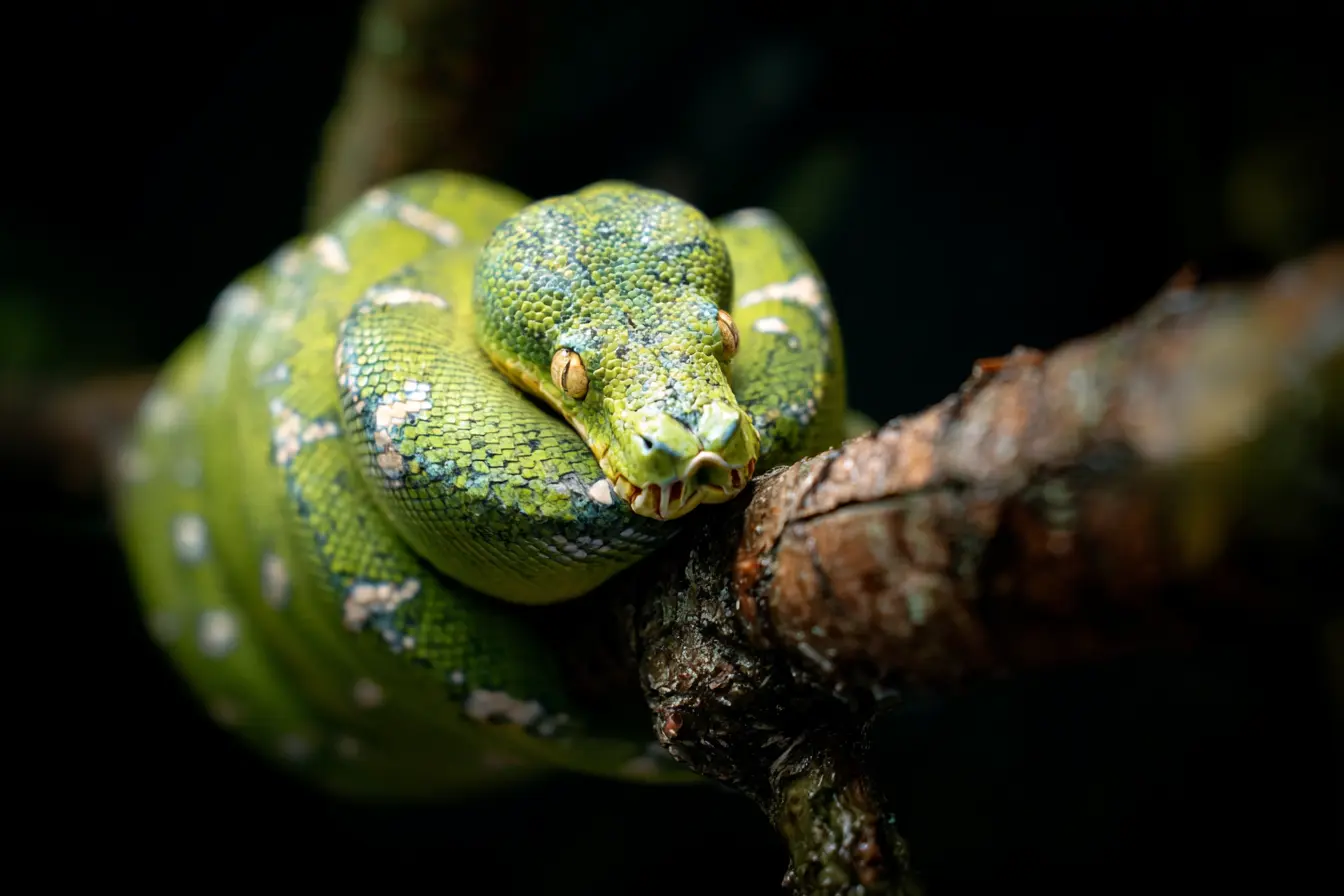
The Green tree python (Morelia viridis) is one of the most visually striking snakes in the world. Famous for its vibrant green colouration, slender body, and signature coiled resting posture, this arboreal python has become a favourite among reptile keepers and photographers alike.
Native to the tropical forests of New Guinea, Indonesia, and northern Australia, the Green tree python is a symbol of elegance and calm precision. While its care demands attention to detail, this species rewards experienced keepers with its beauty and fascinating natural behaviour.
Origins and Natural Habitat
The Green tree python inhabits the humid tropical rainforests of New Guinea, the surrounding islands, and the Cape York Peninsula in Australia. These snakes live high in the forest canopy, spending most of their lives coiled on branches near the forest floor or mid-level vegetation.
The rainforest provides stable temperatures, high humidity, and dense foliage. The Green tree python’s bright green colour offers excellent camouflage among the leaves, while juveniles, often yellow or red, blend into the dappled sunlight of the forest understory.
Appearance and Temperament
Physical Traits
- Size: Adults typically reach 1.2–1.8 metres in length
- Colouration: Adults are bright green, sometimes with blue or yellow highlights; juveniles are red, orange, or yellow and change colour as they mature
- Build: Slender and muscular with a prehensile tail for gripping branches
- Head: Triangular and broad with large heat-sensing pits for detecting prey
Behaviour and Temperament
Green tree pythons are largely nocturnal and ambush-oriented. During the day, they coil neatly over branches with their head resting in the centre of the loops, a classic pose that makes them instantly recognisable.
While often calm when left alone, they can be defensive if disturbed, especially at night. With careful, minimal handling and patience, many individuals become settled and tolerant of light interaction. However, they are best kept as display animals rather than frequent handling pets.
Housing Requirements
The key to successfully keeping a Green tree python lies in replicating its warm, humid, arboreal environment. A vertically oriented, well-ventilated enclosure is essential.
Enclosure Size
- Juveniles: 45 cm x 45 cm x 60 cm
- Adults: Minimum 90 cm x 60 cm x 90 cm, with more height always beneficial
Tall enclosures with multiple perches allow natural climbing and resting behaviour. Glass or PVC enclosures are ideal for humidity control, but good airflow must be maintained.
Heating and Temperature Gradient
- Basking area: 31–32°C
- Ambient temperature: 27–28°C
- Night-time: Drop to around 24°C
Use radiant heat panels or ceramic heaters controlled by a thermostat to provide consistent warmth. Avoid strong direct heat sources that could burn the snake, as these snakes often perch close to their heat.
Lighting and UVB
Although nocturnal, Green tree pythons benefit from low-level UVB (2–5%) lighting. This supports natural vitamin D3 production and contributes to overall wellbeing. Provide a 12-hour day-night light cycle to mimic tropical conditions.
Soft, diffused lighting enhances their vibrant colouration without causing stress.
Humidity and Water
Maintain humidity between 70–90%, allowing it to rise slightly at night. Regular misting and a large water bowl help achieve this. A balance between humidity and ventilation is critical, air should be moist but not stagnant.
Misting also encourages natural drinking behaviour, as these snakes often lick water droplets from leaves and branches.
Substrate and Furnishings
- Substrate: Coconut fibre, sphagnum moss, or cypress mulch for moisture retention
- Perches: Provide several horizontal and diagonal branches of varying thickness for climbing
- Foliage: Use live or artificial plants for cover and humidity
- Hides: Offer shaded areas or dense foliage to give the snake security
Arrange branches at different heights and positions, as these snakes prefer perching above ground level with clear visibility of their surroundings.
Diet and Feeding
Green tree pythons are ambush predators, feeding on small mammals, birds, and occasionally reptiles in the wild. In captivity, their diet is straightforward but must be managed carefully.
Feeding Schedule
- Juveniles: Every 7–10 days
- Adults: Every 2–3 weeks
Food Items
Feed appropriately sized frozen-thawed rodents, such as pinkie or fuzzy mice for young snakes, and adult mice or small rats for adults. The prey should be roughly equal to the snake’s midsection in diameter.
Feeding at night is often most successful, as these snakes are naturally more active and responsive in low light.
Feeding Tips
Offer food using tongs to prevent accidental bites. Avoid overfeeding, these snakes can become overweight if fed too often. After feeding, allow 48 hours before handling to ensure proper digestion.
Handling and Interaction
Green tree pythons are best admired rather than handled frequently. They can be defensive, particularly when resting, and their arboreal nature makes ground handling stressful.
When handling is necessary (for cleaning or health checks):
- Approach calmly from below or the side, never from above
- Use a snake hook to gently lift and support the body
- Move slowly and support the full weight of the snake
- Limit handling to short sessions
With consistent care and respect, many individuals become more tolerant of occasional interaction.
Common Health Concerns
Respiratory Infections
Caused by incorrect temperature or humidity levels. Symptoms include wheezing, bubbling at the nostrils, or lethargy.
Shedding Issues
If humidity is too low, incomplete sheds may occur. Provide a humid hide and increase misting during the shedding cycle.
Scale Rot
Often due to damp, dirty substrate. Keep the enclosure clean and allow areas of dryness.
Stress and Anorexia
Frequent handling or poor environmental conditions can cause stress, leading to feeding refusal. Maintain a quiet, stable environment to avoid these problems.
Regular cleaning, temperature monitoring, and humidity control are the best ways to keep this sensitive species healthy.
Lifespan and Breeding
Green tree pythons are long-lived snakes, typically surviving 15–20 years in captivity, with some individuals exceeding 25 years.
Breeding is well established among experienced keepers. Mating is triggered by slight drops in temperature and changes in humidity. Females lay 10–25 eggs, which hatch after 50–60 days at around 31°C. The hatchlings are usually bright yellow or red, transforming into vivid green over the first year.
Conclusion
The Green tree python is a true masterpiece of evolution, an elegant, vibrant, and intelligent inhabitant of the rainforest canopy. Its beauty is rivalled only by its fascinating behaviour and specialised adaptations to life among the trees.
While its husbandry requirements are demanding, dedicated and experienced keepers find this species deeply rewarding. With the right environment, careful observation, and respect for its arboreal nature, the Green tree python thrives in captivity, offering a glimpse into the vibrant, mysterious world of the tropical rainforest.
For those prepared to meet its needs, this living emerald is a jewel worth every effort.
Quick questions
- What should I know about green tree python?
- The Green tree python is a visually striking snake, known for its green colour. It originates from the tropical forests of New Guinea, Indonesia, and northern Australia. This arboreal snake thrives in warm, humid environments and. Vet Verified can help you compare UK veterinary practices by location, species, services and opening hours before you call.
- When should I contact a vet about green tree python?
- Contact a veterinary practice if your pet seems unwell, symptoms are getting worse, you are unsure what to do, or the situation may be urgent. Vet Verified helps you compare practice details, but a vet should advise on your pet's current care.
- Can Vet Verified help me find exotic vets?
- Yes. Use Vet Verified to compare exotic vets across the UK, then check practice profiles and call directly to confirm current availability.
Find a vet
Need a vet for this?
Use Vet Verified to compare UK veterinary practices that match this topic, then call the practice directly to confirm current services and availability.
Search by species
- Exotic vets Find UK veterinary practices that list exotic pet care. Compare practice profiles, opening hours, contact details and verification signals.
- Bird vets Find UK veterinary practices that list care for birds. Compare practice profiles, contact details, opening hours and verification signals.